
The journal
How to keep fitted sheets from slipping off a mattress? Practical fixes and buying steps
how to keep fitted sheet on mattress: practical steps to measure pocket depth, choose deep-pocket sheets, use straps and tuck properly to stop slipping.

Why fitted sheets slip and the simple first steps to fix it
Picture this: you wake up, the fitted sheet has rolled off one corner, and the mattress looks half exposed. If you are wondering how to keep fitted sheet on mattress, start by looking at the match between the sheet and the true mattress depth, including any topper or protector; that mismatch is the most common reason sheets pop off, and checking it is the fastest first step you can take Sleep Foundation.
Many other causes are familiar: a sheet labeled for a shallower mattress stretches thinly over a tall mattress and releases at the corners, corner-only elastic offers less hold than a full elastic channel, and worn elastic loses tension over time. Testing and buying guides point to sizing and elastic type as primary factors to check when sheets slip.
Start tonight with two low-effort actions that often stop immediate slipping: retuck every corner carefully, pulling fabric well under the mattress, and if you have a strap or clip on hand, attach it to one corner to see if it holds through a night; practical how-to guides list these as effective quick fixes you can try before buying anything new.

If those quick moves fail, resist the urge to keep stretching the same undersized sheet, which can speed elastic wear. Instead, make a short plan that starts with measuring true mattress height, then choosing deeper-pocket or extra-deep sheets if needed, and finally adding mechanical anchors only if fit and tucking do not solve the problem Wirecutter bed sheets guide.
For a step-by-step buying checklist and measurement worksheet, visit the Talk About Sleep resource hub to compare pocket depths and find guidance on what to measure before you shop.
How to keep fitted sheet on mattress: measure and match pocket depth
The clearest, most reliable fix for sheets that pop off is to measure your mattress and match that measurement to the sheet's pocket depth. To begin, measure from the mattress base up to the top of any topper or protector, because those layers add to the height a sheet must cover Sleep Foundation.
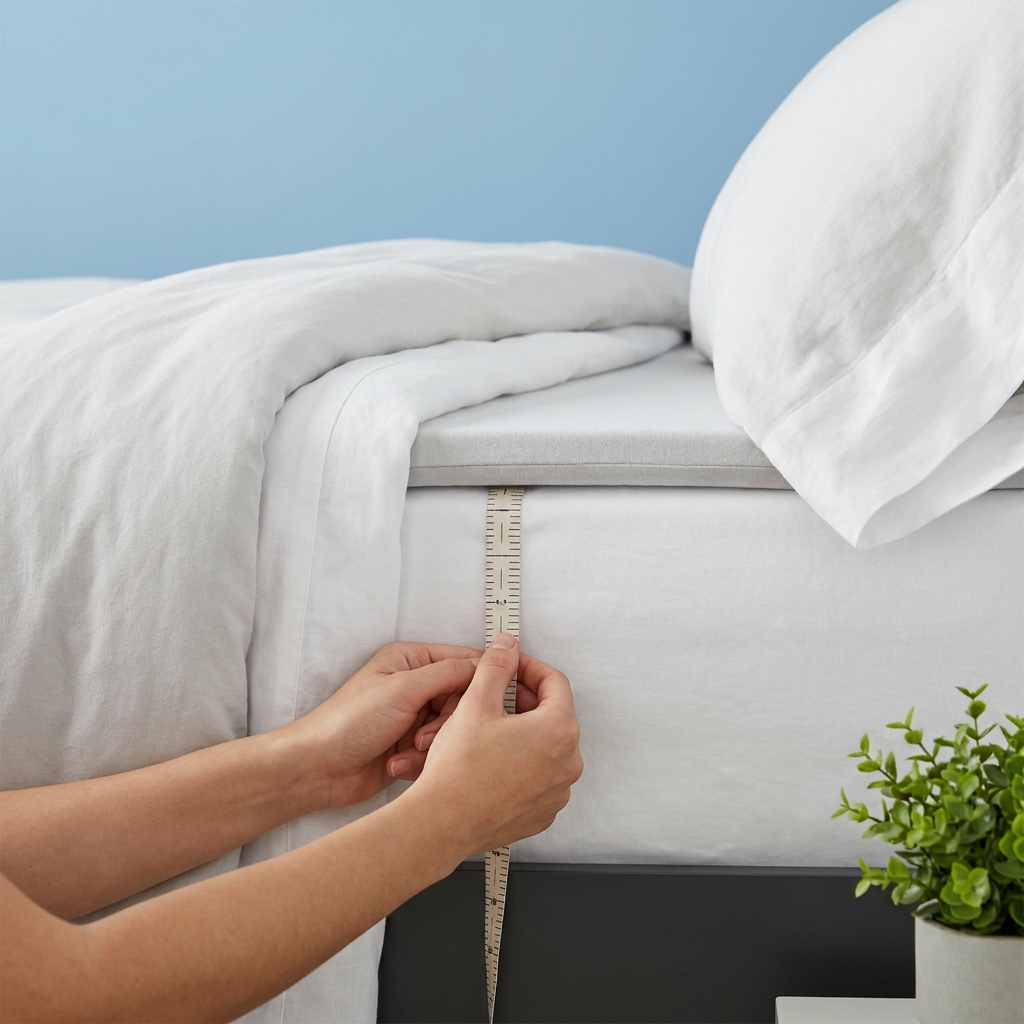
Step 1, place the tape measure at the mattress foundation level where the sheet will tuck, then extend it to the highest point of the topper or protector. Step 2, record that number as the true mattress height. For example, a 12 inch mattress with a 2 inch topper is a 14 inch height and requires a sheet with at least a 14 inch pocket to sit properly without strain Wirecutter bed sheets guide. See a measurement guide that outlines common mattress and pocket sizes.
When you read product pages, look for the stated pocket depth and compare it to your recorded measurement. Many manufacturers offer categories labeled deep-pocket or extra-deep, and those are intended for taller mattresses or for sets that include protectors and toppers Sleep Foundation.
Be cautious because labeling is not standardized across brands, so a "deep-pocket" tag on one page may mean something slightly different on another. Confirm the numeric pocket depth when possible, and, if the brand lists a cut or finished dimension, prefer that over vague category names Wirecutter bed sheets guide. For another measurement approach, see this how-to on measuring mattress depth from a bedding guide.
If you find your sheet is undersized by half an inch to an inch, you might still be able to improve fit by tucking differently, but if the difference is larger, choose a deep-pocket or extra-deep option designed to cover the full height without stressing the elastic Sleep Foundation.
Sheet design that holds: full-perimeter elastic, fabric and fit
Is full-perimeter elastic worth it for my bed size?
What is the single most reliable fix when a fitted sheet keeps slipping off?
Measure the mattress including any topper or protector and choose a sheet with a pocket depth that matches that total height; if fit is correct and slipping persists, use a corner strap as a test.
Testing-focused buying guides consistently report that sheets with full-perimeter elastic, which runs around the entire hem, hold better than those that only have elastic at the corners. Full-perimeter elastic reduces the chance a corner will work free under movement and provides a more even tension across the mattress edges. See related Talk About Sleep buying guides here.

Material and weave also influence how well a sheet grips. Heavier weaves and textured finishes create more surface friction on a mattress cover than very slick weaves, and that extra friction helps sheets stay put without mechanical aids. Look at product descriptions for fabric weight, weave type, and whether the elastic is described as reinforced or full channel when choosing new sheets Wirecutter bed sheets guide.
On product pages, scan for three key items: the numeric pocket depth, a description of full-perimeter elastic or an elastic channel, and clear care instructions that include pre-washing guidance. A good return policy is also valuable, because pocket depth labels vary and you may need to test fit at home.
If you already own a set with corner-only elastic, you can still improve hold by combining better tucking with a strap solution. But when you are buying new sheets for a tall bed or a bed with a topper, prioritize full-perimeter elastic and correct pocket depth first Wirecutter bed sheets guide.
Accessories that work: sheet straps, grippers and when to use them
If a correct-size sheet still shifts, cross-tension accessories anchor the corners mechanically and usually solve persistent slipping without changing comfort. Sheet straps, corner clips and grippers attach under the mattress or to the sheet and create opposing tension that holds fabric in place.
Types vary in attachment and feel. Elastic straps pair two corners diagonally under the mattress and are simple to fit, while corner clips fasten directly to sheet fabric. Non-slip pads placed between mattress and sheet add friction without tension. Each type has pros and cons for ease of use, permanence and potential to stretch fabric over time. For guidance on depth ranges by mattress type, see this fitting guide that summarizes standard and deep-pocket categories.
Test one corner with a strap before committing to all corners
Try a temporary strap on a single corner first, then sleep on the bed a night to confirm it resolves the shift. If the strap holds that corner reliably, fit all four corners with the same style of strap, unless you prefer a pad or clip solution for comfort reasons.
Accessories are most useful when the sheet is close to the right size but still moves, or when you need a quick and low-cost fix. If your sheet is clearly too shallow, plan to replace it with a deep-pocket option rather than rely on straps long term, because a proper fit preserves elastic life and looks neater.
Bed-making technique and common mistakes that cause sheets to pop off
How you make the bed matters. Anchor each corner by pulling the sheet down and tucking the excess fabric firmly under the mattress, instead of leaving a loose fold at the side. That simple increase in friction reduces the chance the corner will work free under movement.
For top sheets, hospital corners give a clean, durable tuck that stabilizes the whole bedding stack. The method locks the sheet under the mattress at the corner and prevents layers from sliding as easily during the night The Spruce guide to hospital corners.
Common mistakes include failing to include the topper or protector in the tucking process, which leaves the sheet too loose at the corner, and pulling the elastic so hard when fitting it that you over-stretch the band. Overstretched elastic loses tension and reduces holding power over time, creating a repeating slipping problem.
A short troubleshooting checklist you can run in the morning after a pop-off: re-measure the true height, check whether the elastic looks worn, retuck corners firmly, try one corner strap, and if the sheet still fails, consider a deeper-pocket replacement. That sequence saves time and helps you avoid buying replacements prematurely Wirecutter bed sheets guide. See more troubleshooting articles on our site.
Care, troubleshooting checklist and quick action plan
Fabric care affects fit over time. Pre-washing some sheet fabrics helps them settle to final size and avoid surprises after the first wash, and avoiding excessive dryer heat reduces shrinkage that can make a previously fitting sheet become too small. These are standard care notes from testers and guides that help preserve elastic performance and long-term fit.
Here is a compact troubleshooting flow you can use: measure true mattress height, compare to pocket depth, test tucking and make one-corner strap trial, then decide whether to replace the sheet with a deep-pocket model or to add permanent straps. If a sheet is more than an inch or so too small, replacement is usually the better long-term solution Sleep Foundation.
Quick checklist before you buy or right after a pop-off episode: 1) Measure mattress plus topper, 2) Confirm numeric pocket depth, 3) Prefer full-perimeter elastic and reinforced channels, 4) Pre-wash if recommended, 5) Test with a single corner strap before committing to accessories, 6) Replace sheets that are clearly undersized or have exhausted elastic Wirecutter bed sheets guide.
One open issue to keep in mind is that pocket depth labels are not uniform across brands, so when possible, choose sheets where the manufacturer lists a numeric pocket depth or finished cut dimension. That small step prevents most fit surprises and reduces returns Sleep Foundation.
Frequently asked questions
How deep should my fitted sheet be if I use a mattress topper?
Measure the mattress base plus the full thickness of the topper and choose a sheet with a pocket depth at least equal to that total height.
Do sheet straps damage my sheets or mattress?
When used correctly, straps are a low-risk way to add corner tension; try a single corner first to check fit and fabric interaction.
Can I stop sheets from shrinking in the dryer?
Pre-wash and dry on low heat or air dry when possible, following the fabric care label to reduce shrinkage and protect elastic.
A working solution usually starts with measuring and matching, then proceeds to design choices, tucking technique and only then accessories. Small checks and a single-corner trial often save time and money. If your sheets still fail after following this checklist, choose a deep or extra-deep set that lists numeric pocket depth and includes full-perimeter elastic for the best long-term result.
References
- https://www.nytimes.com/wirecutter/reviews/best-bed-sheets/
- https://www.thecompanystore.com/bed-sheet-sizes-and-measurement-guide.html
- https://www.ilovelinen.com.au/blogs/journal/how-to-measure-your-mattress-for-a-fitted-sheet?srsltid=AU7gw4UO8S2exJ9YswWMQKxOtpjxQea1QOmzANCk65PurtCyG42lsG4w
- https://www.talkaboutsleep.com/articles/
- https://www.thespruce.com/how-to-make-hospital-corners-1900837
- https://barehome.com/blogs/main/the-complete-guide-to-choosing-the-right-size-bed-sheets-without-the-guesswork?srsltid=AU7gw4VnafCNgl8rQOxDGJ2PLwTiZyTVWmIIcDHWeC2zde0V4_MfdXei
Product options for this topic
As an Amazon Associate I earn from qualifying purchases. These are researched options, not hands-on test results. Check the exact size or model, current price and availability on Amazon.
| Product option | Fit and limits to check | Retailer |
|---|---|---|
| Mellanni Iconic Collection Microfiber Sheet Set | A fitted-sheet set option. Confirm mattress size and depth, including any topper, rather than relying on the pocket-depth label alone. | View on Amazon |
| Utopia Bedding Bed Sheet Set | An alternative sheet set. Check exact mattress dimensions, fitted depth, fabric and care label before buying. | View on Amazon |